Know the tool
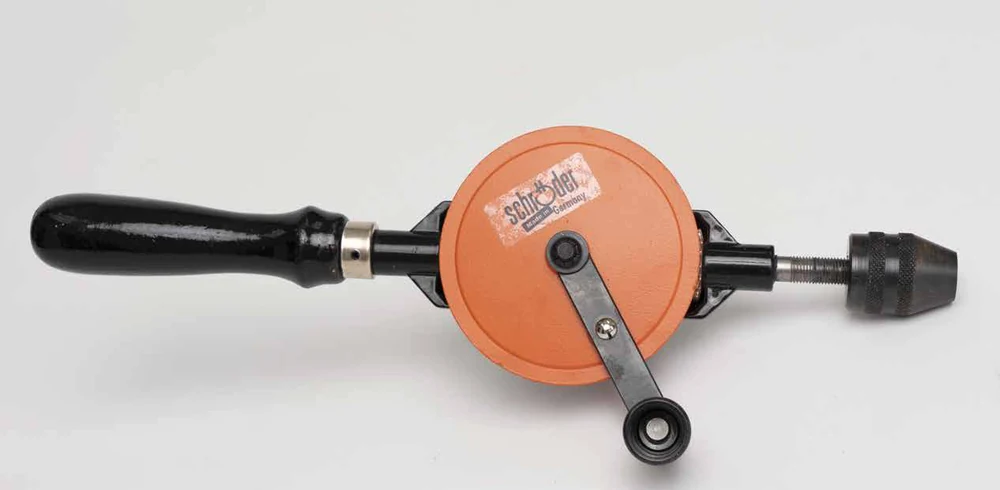
Your goal: Keep a small bit aligned while turning the crank smoothly on a secured sample.
Turning the side crank drives gears that rotate the chuck and bit. The handle supports the tool while the crank hand supplies rotation; neither hand holds the workpiece.
Identify the main handle, crank, exposed gears, chuck, and bit. Keep fingers, hair, and clothing clear of moving parts.
Watch and prepare
At your station
- An inspected hand drill with an instructor-installed small bit and selected depth guide.
- A marked, secured scrap, approved backing/support, eye protection, and a clear turning space.
Demonstration and setup
- Watch the instructor select the bit, check chuck grip, secure the sample, and demonstrate alignment and withdrawal.
- Use light pressure and a controlled crank speed suited to the actual bit and material. Keep the bit aligned instead of forcing it.
- Identify the bit's full path and selected depth; keep hands out of the exit area and away from the gears.
Practice
Start after the demonstration and the instructor's setup check. Stop and ask for help if the work moves or the tool does not behave as demonstrated.
Check the station.
Show the instructor the center mark, depth guide, backing, and workholding. Check crank clearance before picking up the drill.
Place and align.
Position the bit at the marked center. Use the demonstrated support grip and check the intended hole angle.
Crank smoothly.
Turn steadily with light pressure. Maintain alignment and stop at the selected depth. Stop immediately if the bit bends, binds, or the material moves.
Inspect the hole.
Withdraw as demonstrated without levering the bit sideways. Set the drill down and compare the hole with the intended position and depth.
Show your skill
Show the instructor these observable results before using the skill in a project:
- The sample stays secured and the moving gears remain clear of hands and clothing.
- The bit stays aligned during controlled cranking without excessive pressure.
- You stop and inspect rather than forcing a small bit through resistance.
Check your understanding
Why is holding the scrap in your free hand a poor substitute for workholding here?
Reveal the explanation
Both hands have tool-control roles, and loose scrap can move or rotate while the bit is cutting. Secure it with the approved station and keep hands out of the bit path.
Answer aloud or on paper, then compare with the explanation.
Use the skill
Use the skill again at the next instructor-approved practice station.
Maplewoodshop materials adapted with permission. Images © Maplewoodshop. Practice tasks and learning checks by STEM Guides. Maplewoodshop.