Know the tool
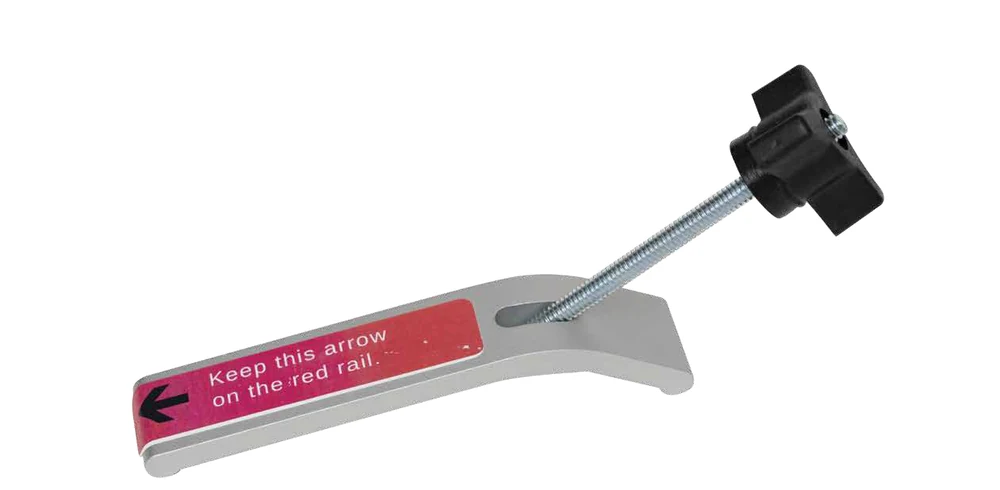
Your goal: Place the short end over the work, support the long end correctly, and test the setup.
This lesson uses the Maplewoodshop screw-operated hold-down. Its short end presses on the work while its long end rests over the bench's red rail, following the label and demonstration.
Identify the short contact end, long support end, threaded knob, and the label showing the rail position.
Watch and prepare
At your station
- The matching bench and hold-down, a flat practice scrap, and any instructor-selected contact pad.
- Cutting tools stay put away during this workholding exercise.
Demonstration and setup
- Watch the instructor match the hardware to the bench and demonstrate both contact points.
- Keep the long end over the red rail as the hold-down label directs. Confirm placement in the actual bench demonstration.
- Keep fingers clear, tighten gently, and leave the intended tool path unobstructed. A hold-down is not automatically needed or sufficient for every operation.
Practice
Start after the demonstration and the instructor's setup check. Stop and ask for help if the work moves or the tool does not behave as demonstrated.
Lay out the setup.
Place the board flat on the approved support. Identify where the later tool will travel and keep that area clear.
Position both ends.
Put the short end over the board and the long end over the red rail as demonstrated. Check the contact before tightening.
Tighten and check.
Turn the knob gently until the work is held. With tools at rest, test stability and ask the instructor to inspect the setup.
Release and reset.
Loosen the knob while controlling the hardware. Remove the free board and return the hold-down to its storage position.
Show your skill
Show the instructor these observable results before using the skill in a project:
- Both ends contact their intended support; the hardware matches the bench.
- The board stays flat and secure while the planned tool path remains clear.
- You release the pressure before trying to remove the work.
Check your understanding
Why does the long end need a proper support as well as the short end on the board?
Reveal the explanation
The arm needs a stable reaction point to press the work down. An unsupported or misplaced end can tip or slip instead of securing the board.
Answer aloud or on paper, then compare with the explanation.
Use the skill
Apply it in a project
Maplewoodshop materials adapted with permission. Images © Maplewoodshop. Practice tasks and learning checks by STEM Guides. Maplewoodshop.